Why you rarely
do what you read.
The problem isn't your memory. It's your workflow.
We designed Instyll to solve the Knowing-Doing Gap.
The Intention-Behavior Gap
A 2016 review of the research reached a blunt conclusion: intentions get translated into action about half the time.
So roughly half of what you decide to do never happens. It's why you highlight books on "Leadership" or "Patience" and still don't act on any of it when it counts.
The problem isn't that you forgot the advice. The problem is that the advice wasn't there when you needed it.
Each dot is one intention.
Based on Sheeran & Webb (2016).
Notes die in your notebook.
You highlight a great quote about "Patience" or "Communication" in a book. You capture it in your notes. Great. But where does it sit? Deep in a folder you never look at.
Three months later, you actually need that advice, maybe during a difficult conversation or a stressful event. Do you open your notes and search for that quote? No. You're busy. You wing it. The knowledge was captured, but not applied.
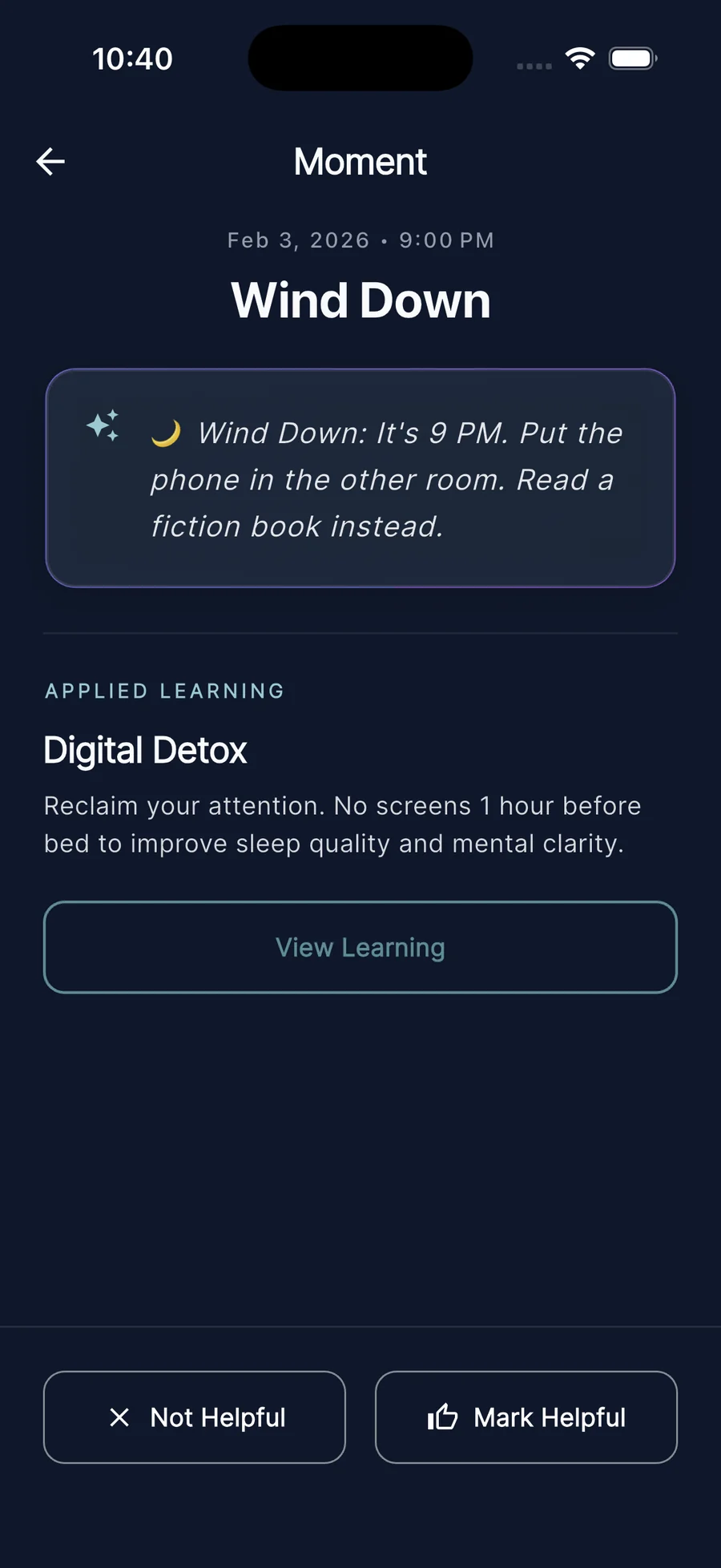
Moments:
Contextual Reminders.
Instyll gives your notes a time and a place, using what psychologists call an implementation intention (Gollwitzer, 1999): a specific if-then plan that's been shown to close the intention-behavior gap.
We read your calendar, from "Strategy Review" to a nightly "Wind Down", and match it against what you've saved.
Just before the moment, it arrives:"It's 9 PM. Put the phone in the other room. Read a fiction book instead."
Work or personal, the note is in front of you at the point where you could actually use it.