The Insight You Never Apply Is Just Entertainment
The Insight You Never Apply Is Just Entertainment
We've read the books. Highlighted the best parts. Maybe even took notes.
We've attended the conferences. Filled notebooks with ideas. Told ourselves we'd implement them Monday.
We've listened to the podcasts. Nodded along. Thought "I should really do that."
And then... nothing.
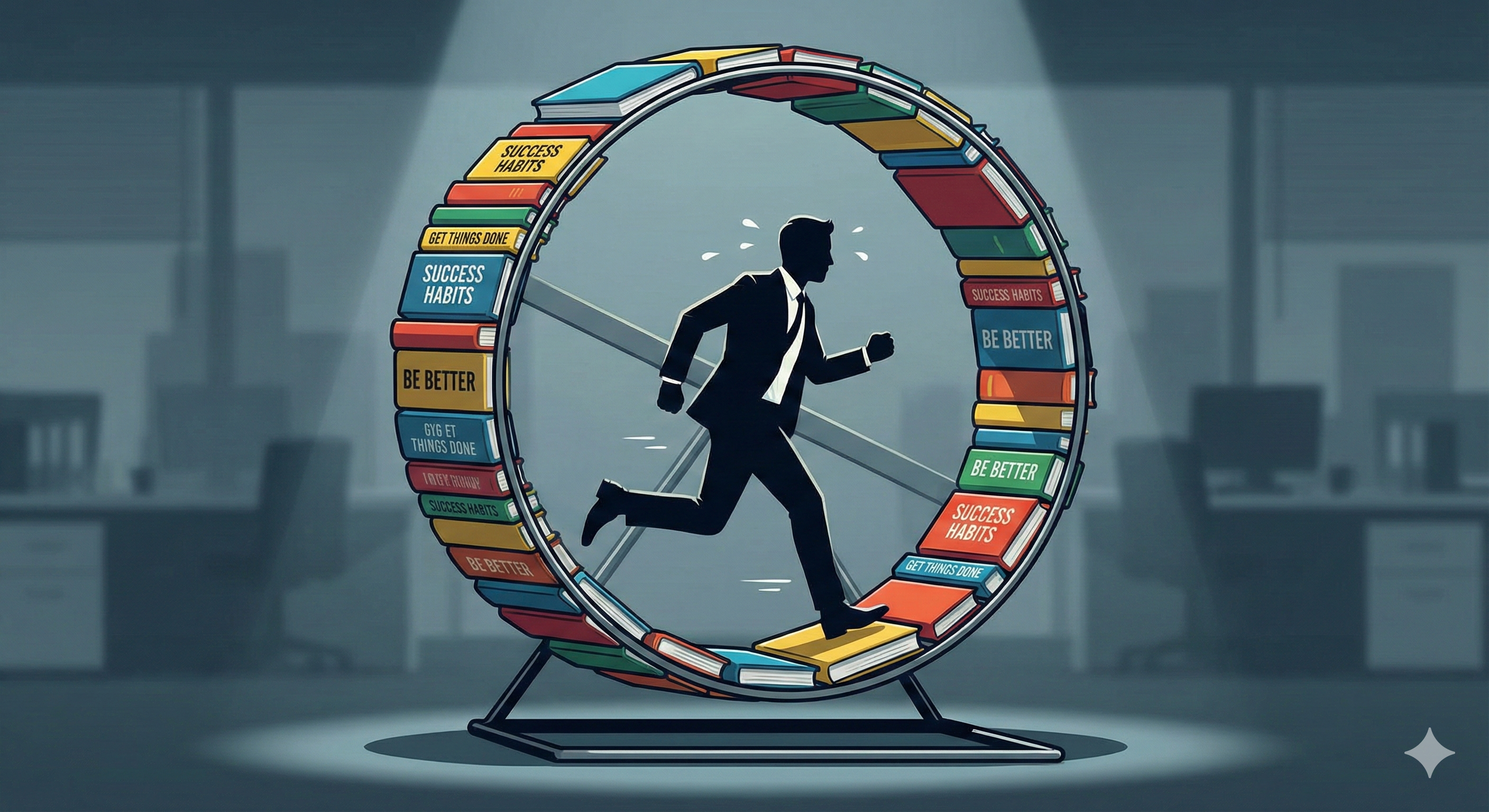
The insight we never apply is just entertainment. It's a comforting performance of self-improvement—the feeling of growth without the friction of change. We consume wisdom, and wisdom consumes our time, and nothing actually shifts.
If this sounds familiar, you're in good company. It's not a character flaw. But it is a problem worth solving.
The Gap Nobody Talks About
There's a quiet struggle among people who care about growing: the gap between knowing what to do and actually doing it.
Stanford professors Jeffrey Pfeffer and Robert Sutton gave this phenomenon a name in their 2000 book: the knowing-doing gap. Their research surfaced a central insight—that one of the main barriers to turning knowledge into action is treating talking about something, or learning about something, as equivalent to actually doing it.
We've gotten good at the learning part. At saving. At collecting. At organizing.
We've built elaborate second brains and knowledge management systems. We've perfected our highlighting workflows. We've curated reading lists that would take three lifetimes to finish.
And yet.
Research across hundreds of studies and tens of thousands of participants reveals a humbling truth: nearly half of people who intend to perform a behavior—exercise, eat better, have that difficult conversation—simply don't follow through. Not because they lack information. Not because they don't know better. But because knowing isn't the same as doing.
The intention-behavior gap runs about 47%. That means for every two intentions we form, roughly one never becomes action. All that reading, all that learning, all that consuming—and still, coin-flip odds on whether any of it changes how we actually show up.
Why Information Doesn't Change Behavior
Here's something the self-improvement industry rarely acknowledges: information alone does not reliably change behavior.
BJ Fogg, the Stanford behavioral scientist behind Tiny Habits, calls this the Information-Action Fallacy—the assumption that if we give people the right information, it will change their attitudes, which will change their behaviors. We believe this so deeply that we keep buying more books, more courses, more content. If we just learn the right thing, surely we'll finally do it.
But behavior doesn't work that way.
Fogg's research shows that behavior happens when three things converge at the same moment: motivation, ability, and a prompt. You need all three, simultaneously. Miss any one, and nothing happens.
Most of us focus on motivation—finding the willpower, the inspiration, the reason to act. Some of us optimize ability—reading about techniques, building skills, preparing endlessly. But almost nobody focuses on the prompt.
And the prompt turns out to be essential.
Without a prompt at the moment of opportunity, even motivated, capable people don't act. They mean to. They plan to. They fully intend to. But intention without a trigger is just a thought that fades.
The Self-Improvement Trap
Researchers examined the 50 top-selling self-help books on anxiety, depression, and trauma. What they found is worth sitting with: only 24% provided any guidance on how readers could measure their progress. Just 34% addressed long-term solutions rather than offering temporary emotional boosts.
Much of self-help content is designed to make us feel something—inspired, motivated, hopeful—more than it's designed to help us do something. The emotional satisfaction of consuming insight can feel remarkably similar to the satisfaction of applying it. Our brains don't always distinguish between the two.
This is why productivity communities have coined the term "productivity porn": consuming content about productivity instead of being productive. It's a form of procrastination that wears the mask of self-improvement.
The uncomfortable pattern looks like this: consume insight, feel inspired, fail to apply, feel guilty, consume more insight to feel better. Repeat.
It's not that we're lazy or lack discipline. It's that we've been sold a model of growth that emphasizes input over output, consumption over application. We've been optimizing the wrong side of the equation.
What Actually Works
If information doesn't change behavior, what does?
The research points to one intervention that consistently works: implementation intentions. The concept is simple but powerful—instead of vague goals ("I want to be a better listener"), you create specific if-then plans that link a situation to an action ("If I'm in a one-on-one meeting, then I will ask at least one open-ended question before offering my opinion").
The effect is surprisingly robust. Across 94 studies, implementation intentions showed a medium-to-large impact on behavior change. A recent meta-analysis expanded this to over 600 tests and confirmed the finding: when you connect an intention to a specific situational cue, you meaningfully increase the odds of follow-through.
The mechanism is elegant. By forming an if-then plan in advance, you essentially delegate the decision to your environment. The situation becomes the prompt. You don't have to remember to act—the context reminds you.
This is the opposite of how most people approach learning. We extract insights from books and talks, store them somewhere, and hope we'll remember them when relevant. But the moment of relevance arrives, and the insight is nowhere to be found. It's buried in a note-taking app, trapped in a highlight, forgotten in a notebook.
The insight was never connected to a trigger. So it never triggered anything.
The Cost of Entertainment Disguised as Learning
Companies spend over $100 billion annually on training in the United States alone. Yet without reinforcement at the moment of application, much of that investment fails to translate into changed behavior. The knowledge exists. The application doesn't.
The personal cost is harder to measure but just as real. How many books have we read that changed nothing? How many conferences have we attended where the ideas stayed in our notebooks? How many podcasts have we consumed that evaporated from memory?
That's not quite learning. That's not quite growth. That's entertainment with intellectual ambitions.
And look—entertainment is fine. There's nothing wrong with reading for pleasure, with consuming ideas for the joy of thinking. But it helps to be honest about what we're actually doing. The guilt and frustration come from the gap between our stated purpose ("I'm reading this to improve") and our actual outcome ("I consumed it and stayed the same").
If we're consuming insight for entertainment, wonderful—enjoy it. If we're consuming it to change, then we need a system that bridges the gap between knowing and doing.
The Shift
Here's the mindset shift that matters: stop optimizing for capture and start optimizing for application.
The goal isn't to read more books. It's to apply one idea from one book.
The goal isn't to take better notes. It's to use one note at the moment it matters.
The goal isn't to save more content. It's to act on one piece of content we've already saved.
Less consumption, more implementation. Fewer insights collected, more insights connected—to specific situations where they can actually shape behavior.
A question worth asking: what insight have we learned in the past month that we've actually applied? If nothing comes to mind, that's not failure—it's information. It means the current approach isn't working, and something different might help.
A Different Approach
We built Instyll because we got tired of being collectors.
Notes everywhere. Highlights from books. Takeaways from conferences. Ideas from podcasts. And a growing sense that none of it was translating into how we actually showed up—in meetings, in conversations, in the moments that mattered.
The problem wasn't the insights. The problem was the gap between having them and using them—the absence of a prompt at the moment of opportunity.
So we built a tool that connects learnings to context. You add an insight—something you want to remember to apply—and Instyll matches it to your calendar. When you have a meeting where that insight is relevant, you get reminded. Before the moment, not after.
It's implementation intentions, automated. The connection between knowing and doing, bridged.
The insight you apply, even once, is worth more than a hundred insights you merely consume.
This is why Instyll exists: not to help you remember more, but to help you do more with what you already know.
Because the insight you never apply is just entertainment.
And you deserve more than entertainment dressed up as growth.